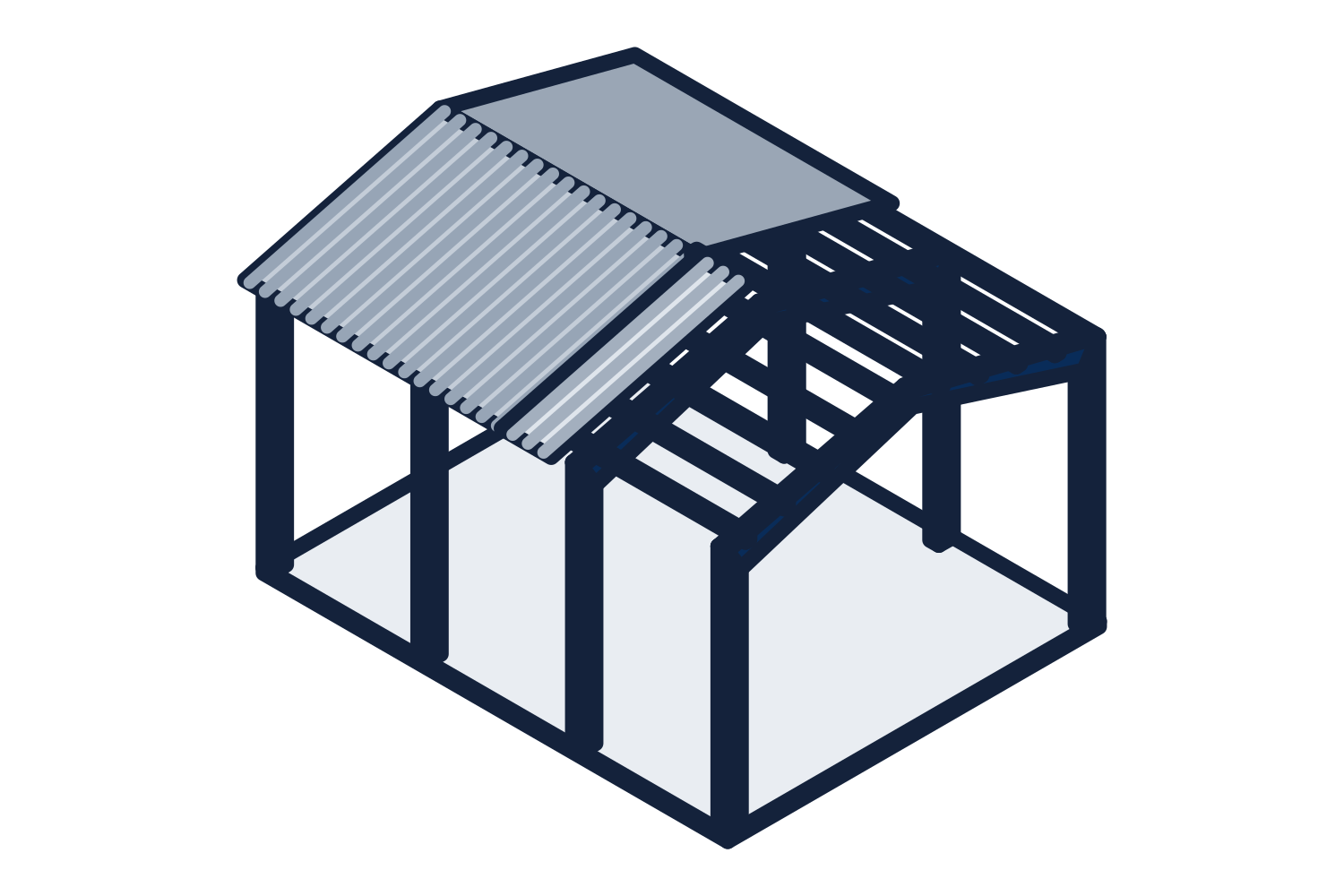
Why a metal building sweats
Air holds water vapor, and warm air holds more of it than cold air. When moist air touches a surface cold enough, the vapor turns to liquid on that surface. The temperature at which that happens is called the dew point.
A steel panel conducts heat well, so its inside face runs close to the outdoor temperature. On a cold night or a cool morning, the underside of an uninsulated roof is often the coldest surface in the building. Moist air reaches it, water forms, and it drips. That is metal building sweating.
Two things have to be present: moisture in the air and a cold surface for it to reach. Every method of control works on one or both.
Representative drawing of the equipment type, not the exact configuration quoted.
Moisture sources inside the building
Before choosing a system, list where the moisture comes from. The use of the building matters more than its size.
- A new concrete slab, which gives off water for a long time as it cures
- Bare ground or a slab with no vapor retarder under it
- Unvented fuel-fired heaters, which put water vapor into the air as they burn
- People, animals, and stored crops or produce
- Wash bays, wet processes, and equipment brought in wet or covered in snow
- Humid outdoor air entering through open doors and then cooling
- Construction moisture from masonry, drywall finishing, and paint
Insulation, vapor retarder, and ventilation as a system
No single product stops condensation. Three things work together, and a weakness in one shows up as water.
Insulation keeps the surface the indoor air touches warm enough that it stays above the dew point. The vapor retarder, often called a vapor barrier in a metal building, is the facing on the room side of the insulation. It keeps moist air from passing through the insulation to the cold panel behind it. Ventilation removes moist air and replaces it with drier air.
The vapor retarder only works if it is continuous. Seams have to be sealed, tears repaired, and penetrations taped. Insulation compressed over the purlins and at the eaves is thinner there, and those lines are where condensation tends to show first. Thermal blocks and careful detailing at those points are part of the system.
| Part | What it does | Where it fails |
|---|---|---|
| Insulation | Keeps the inside surface above the dew point | Gaps, compression at framing, and wet insulation |
| Vapor retarder | Keeps indoor moisture out of the insulation | Unsealed seams, tears, and open penetrations |
| Ventilation | Carries moist air out and brings drier air in | Too little air movement, or vents that are closed in winter |
| Source control | Reduces the moisture released indoors | Unvented heaters and a slab with no vapor retarder under it |
| Insulated metal panels | Put the insulation and the inner skin in one sealed panel | Unsealed joints between panels and at trim |
Condensation-control membranes for unheated buildings
For a building with no heat and no insulation, such as cold storage for equipment, there is another option. Roof panels can be ordered with a condensation-control membrane applied to the underside at the factory. The membrane is an absorbent layer. It holds the moisture that forms on the panel overnight and releases it back to the air as the roof warms.
It has limits. It is not insulation, and it does not replace a vapor retarder in a heated building. It needs air movement to dry out, so the building still needs ventilation. If the building takes on more moisture than the membrane can hold, it will still drip. It suits unheated buildings with modest moisture and good airflow.
What to decide before ordering
These choices change the roof and wall system, so they belong on the request for a quotation and not on a change order.
- Will the building be heated, cooled, or neither, now and later?
- What is the use, and what moisture does it put into the air?
- Does the energy code apply to this building, and what does it require of the roof and walls?
- Which insulation system: faced blanket insulation, a liner system, or insulated metal panels?
- Which roof: through-fastened or standing seam, and how the insulation is detailed with it?
- What ventilation: ridge vents, wall louvers, powered exhaust, or mechanical equipment?
- Is a vapor retarder going under the slab? That is a foundation decision, by others, and it matters here
Ordering it right
Tell us the use, whether the building is conditioned, and what the energy code requires. The quotation states the insulation system as its own line. The insulation values come from the energy code and your designer, not from us.
Packages are sold through contractors and erectors, so owners should bring their builder or tell us who is building it. The erector's care with seams and penetrations is what makes the vapor retarder work. The package builder on this site asks about the envelope, single skin or insulated metal panel, as one of its steps.